
Groans Too Deep for Words

I’ve been in Tuscaloosa a little over a week now, long enough to know which trail entrance doesn’t require me to cross traffic, not long enough to stop checking my phone for directions to the coffee shop I’ve already been to four times. I rode my mountain bike Friday morning before the heat set in, and even before the heat set in, I was drenched. The trail here is smoother than the ones I know at home, sandier in the low spots, more forgiving of a stranger still figuring out where the roots are. I never found that state I chase on the trails near my house, where the bike and the ground and my brain stop being three separate things. I know that state well enough to notice its absence. It was still a good ride. It just wasn’t that.
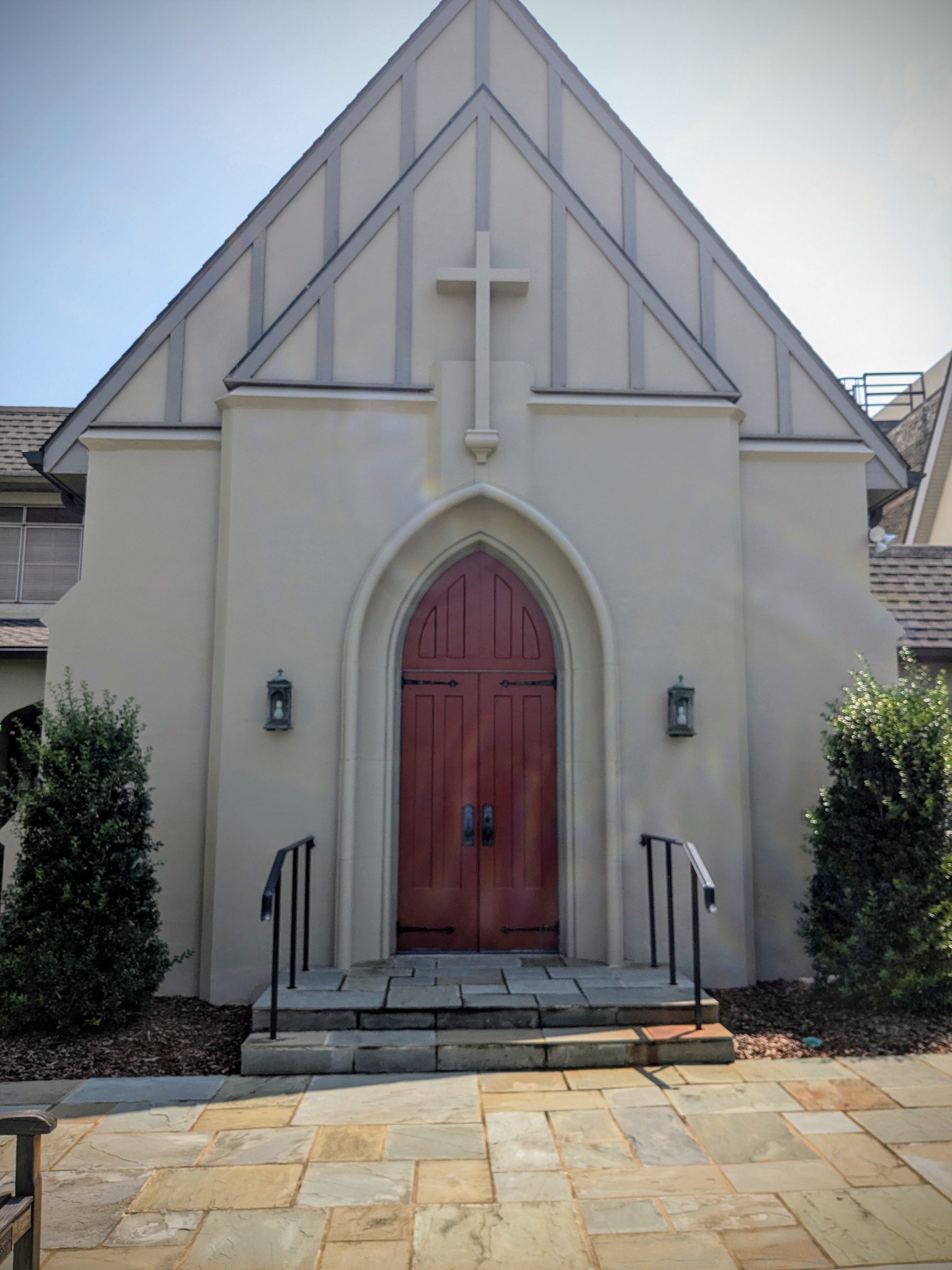
I ran earlier in the week too, and will probably run again today once it cools off. It’s a beautiful city, live oak and red brick, Spanish moss doing its slow-motion thing in the humidity. But most of what I want to tell you about happened somewhere I wasn’t moving at all: a pew, on Sunday morning, at the Episcopal church I’d found because it was close and because some habits don’t need much more reason than that.
How Can I Keep From Singing
I didn’t know until I sat down that it was a Hymn Sing—well, sort of. I knew it the night before when I looked up the church calendar since I am slightly neurotic about schedules and such things.
The priest built his sermon around “How Can I Keep from Singing?” as its text. Twelve hymns, by my count, favorites stacked on favorites:
Sanctuary (”Lord, Prepare Me”)
All Creatures of Our God and King
Come Thou Fount of Every Blessing
I Love to Tell the Story
It Is Well with My Soul
He Leadeth Me
I Cannot Tell (Londonderry Air)
Shepherd of Souls, Refresh and Bless
Great Is Thy Faithfulness
Be Still, My Soul
Jerusalem, My Happy Home
Onward, Christian Soldiers
It Is Well with My Soul is the one that always finds me, tangled up as it is with Doug Boldt. I’ve written elsewhere on this Substack about learning to grieve the dead; I won’t retell it here, except to say the hymn doesn’t stay in the past when it’s playing.
It surprised me a little how full the service was, how vibrant, in a new place among people I didn’t know yet, and it was familiar in the way liturgy always is no matter which building you’re sitting in. I sang loud and let myself mean it.
Seven Years for the Wrong Woman
The Old Testament reading was Genesis 29:15-28, and if you don’t remember it, here’s the shape of it: Jacob works seven years for Laban to marry Rachel, the woman he actually loves, and on the wedding night Laban swaps in Leah instead, the older daughter, the one nobody asked for. Jacob works another seven years to get the woman he wanted in the first place. Laban’s justification amounts to a technicality: it’s not done in our country to marry off the younger before the firstborn, a rule invoked exactly when it’s convenient, to cover what is actually just deception with a fig leaf of custom.
My brain snagged on that the way it snags on details, unbidden: fourteen years spent because of a technicality standing in for what was actually a betrayal. Then there’s the problematic logistics implied here. Jacob goes into a dark tent to “go into [his wife]”— a not-so-subtle euphemism for sexual intercourse, and you are telling me he didn’t know it wasn’t Rachel? I don’t know what to do with that story theologically except to notice how old this move is, using the letter of a law to justify something the spirit of it would never permit. People have been doing that to each other for a very long time.
Groans Too Deep for Words
Then Romans 8:26-29 and 38-39, and this is the part I actually want to talk about. Paul writes that the Spirit intercedes for us “with sighs too deep for words,” and that nothing can separate us from the love of God. (Side note: if you have small children or have ever spent time near a Seed Kids video, you know the one I mean, the one about nothing being able to separate us. I have hummed it in the shower three times since Sunday. It’s a serious earworm, and I mean that as a compliment. I’ve included it below, but hearer beware.)
The priest picked up that phrase, sighs too deep for words, and did something with it I haven’t stopped thinking about. He said music can intercede for us the same way, that it goes places language doesn’t reach, that when we don’t have the words, and we often don’t, the tune carries what the sentence can’t.
I’ve written about this before in a different register: emotional salience, the way certain inputs bypass our analytical processing and land directly in the part of us that feels before it thinks. I’ve mostly used that language to talk about grief, the way a certain hymn can undo me faster than any sermon. But I hadn’t quite put together that this might also be a description of the Holy Spirit’s actual job, groaning where we can’t and reaching where words give out. If the Spirit intercedes with sighs too deep for words, and music also operates below and beside language, maybe music isn’t decoration on top of the theology. Maybe it’s doing some of the same work.
I hold that loosely. But it’s the kind of loose holding that keeps rearranging my furniture.
The Gospel was the string of parables in Matthew, the kingdom of God like a mustard seed, like yeast, like treasure a man stumbles on and sells everything for, each one an attempt at describing something that keeps refusing to be described directly. It occurred to me, sitting there, that this is the same problem from a different door. The kingdom of God doesn’t reduce to a sentence either. You circle it, reach for it sideways, with a seed, or a song.
Every Restaurant Has a Soundtrack
I should tell you what it’s like here, because it’s different from home in a way I’m still noticing.
The hospitality is real and constant, not performed. People ask how your day’s going and actually wait for the answer. There are churches everywhere, more per city block than I’ve counted anywhere I’ve lived, and contemporary Christian music plays over the speakers in coffee shops and sandwich places, less like background noise than like a house style. Faith is worn openly here, in bumper stickers and casual conversation with strangers who have no reason to know you.
Lord, Forgive Me
More than three people this week, unprompted, have brought up their faith with me. Strangers. At the bike shop. In line somewhere. I presume they’re evangelical, by the shape of the language they use, and every one of them was warm and unguarded about it, no agenda I could detect, just people telling me something true about themselves the way you’d mention your kids or your dog.
I braced for it each time. I expected to feel cornered, like I was about to become someone’s project. That’s the exvangelical wiring, the scar tissue from a version of Christianity that used friendliness as a door-opener for something more transactional. I didn’t feel that. I felt talked to. It didn’t hurt, and I noticed it not hurting, which is its own small strange thing.
And underneath the noticing was something less comfortable: I’ve been holding a quiet judgment toward people like this for a long time, not the specific people in front of me this week, but the category, their evangelical-ness, the easy talk of blessing and the music playing over the sandwich shop speakers. I’ve treated that whole cultural register as something to be a little embarrassed by, or wary of, or above, and that posture has nothing to do with these particular people, who were only ever kind to me. It’s mine, something I made and have been carrying around like it was discernment instead of what it actually is.
This is my sin. Lord, forgive me.
I don’t have a tidy way to close that out, and I’m not going to manufacture one. I know the shape of my own judgment a little better than I did a week ago, which is not nothing, even if it isn’t resolved.
Tonight, when it cools off, I’m going for a run.
Your trip is providing re-creation in unexpected places. Your insights on music and strangers, especially, resounded with me.